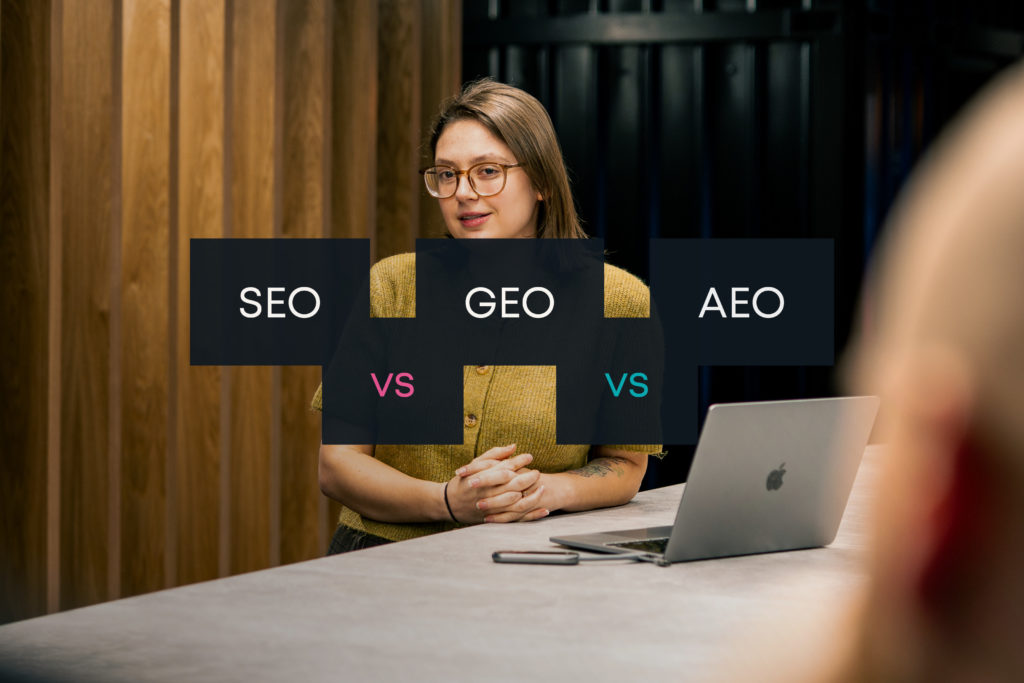
SEO vs GEO vs AEO: How To Dominate Every Search Result
Back in the day, optimisation was all about search engines. But in the ever-changing digital landscape we call marketing, there’s now much more happening behind the scenes in order to get your brand noticed.
The real conversation is SEO vs GEO vs AEO – understanding what works, how to track performance, and why we’re moving beyond raw organic traffic numbers.
Let’s search for some answers, shall we?
Search Engine Optimisation (SEO)
We all know what keywords are. In the simplest terms, keywords or search terms are the specific words and phrases people type into search engines like Google to find what they’re looking for. So, if a business searches for ‘digital marketing agency in Shrewsbury’, guess who’ll pop up (thanks to two of our SEO specialists Huw and Jess).
A backlink in SEO is essentially a vote of confidence that signals quality, credibility, and authority to search engines. Both high-quality, relevant keywords and backlinks are crucial for ranking higher in search results, driving referral traffic and enhancing organic visibility.
At Reech, our performance and marketing team weave SEO strategies into our client’s content, from blogs and articles to web pages and FAQs. Instead of sticking to static strategies, we work alongside moving trends. Only a couple of years ago, AI search wasn’t on our radar. Now we build AI and LLMs into SEO strategies that dominate.
Generative Engine Optimisation (GEO)
GEO is easily described as the evolution of SEO, shifting focus from ranking links to being featured in conversational AI answers.
33% of people now use AI tools for product research. AI tools like ChatGPT, Perplexity, Gemini and Copilot are an everyday tool for a lot of people, both personally and for business. So, as the way people search and technology has evolved, so does the way we optimise.
Interestingly, there is 165x faster growth in AI search vs traditional search. It’s crucial to include in your digital marketing and performance strategies if you want to be visible against your competitors.
This biggest difference between SEO and GEO is the type of content that works. For SEO, keywords are very robotic, to the point that obvious optimisation has been nicknamed ‘keyword stuffing’ – copy that sounds silly, makes no sense, and is clearly only written for search results. For GEO, it goes in the opposite direction, to reflect a conversation. When copy is like a conversation, with contextual relevance and brand sentiment, it is more AI search engine-friendly.
Answer Engine Optimisation (AEO)
AEO is the further evolution of GEO, where online content is structured to be easily understood, summarised, and cited by AI-powered tools.
Direct, zero-click answers, often appearing as AI Overviews, are everywhere. 55% of organic searches have AI overviews, so if you want your content seen – it’s time to optimise with AEO in mind.
But why? In short, we’re getting lazier and our attention spans are becoming even less patient. 60% of Google searches are zero-click, meaning users can mostly always get information they need directly on the search results page without clicking through to any website. A previous blog of ours goes into the 3 Second Rule and short form content, but for you, it means making sure your content is snackable and easily citable, or it may never be seen hidden behind website links instead of in featured snippets on the results page.
Well, We’re Doing Something Right.
We’ve worked hard to understand and incorporate SEO, GEO and AEO strategies into our clients and our outputs. Whether you found us through a Google search, AI question or word of mouth, our strategies must be working.
Get in touch if you need help with your optimisation strategies: https://reech.agency/contact-us/
Frequently Asked Questions:
-
SEO helps content rank in traditional search engines like Google by focusing on keyword targeting, backlinks, and metadata to appear in search engine results pages (SERPs). GEO, on the other hand, focuses on optimising content for AI-driven search engines like Microsoft Copilot and ChatGPT, aiming to be included in AI-generated answers and conversational responses rather than multiple search results pages.
-
No, GEO is not replacing SEO. Instead, it builds on a solid SEO foundation by adapting content to be machine-readable and contextually relevant for AI-powered platforms. While SEO drives website traffic through traditional search rankings, GEO increases brand visibility and authority within AI-generated responses and citations.
-
To succeed in both SEO and GEO, it’s important to create high-quality, well-structured content that aligns with user intent and search queries. Incorporating schema markup and structured data helps AI systems understand and cite your content accurately. Additionally, regular content audits, mobile friendliness, and link building contribute to improved rankings and AI visibility across multiple search platforms.
As SEO and GEO continues to change, we develop our SEO strategies to work alongside it. If you need help or advice with your optimisation strategies, do not hesitate to reach out, where we can talk about the current SEO strategies that are working: https://reech.agency/contact-us/
-
Traditional SEO success is measured by keyword rankings, organic traffic, and click-through rates using tools like Google Analytics. GEO success, however, is gauged by brand visibility in AI-powered platforms, including citations in AI-generated answers, mentions in AI Overviews, and overall, AI visibility. Because GEO often leads to zero-click searches, businesses should also track impression metrics, and brand mentions across AI search engines and AI-powered platforms.
-
AI-driven search engines provide direct answers and summarised multimodal responses, which has led to a rise in zero-click searches where users get the information they need without clicking through to websites. This shift changes search behaviour and can reduce website traffic, making it essential for businesses to optimise for both traditional SEO and GEO to maintain visibility and qualified traffic.